
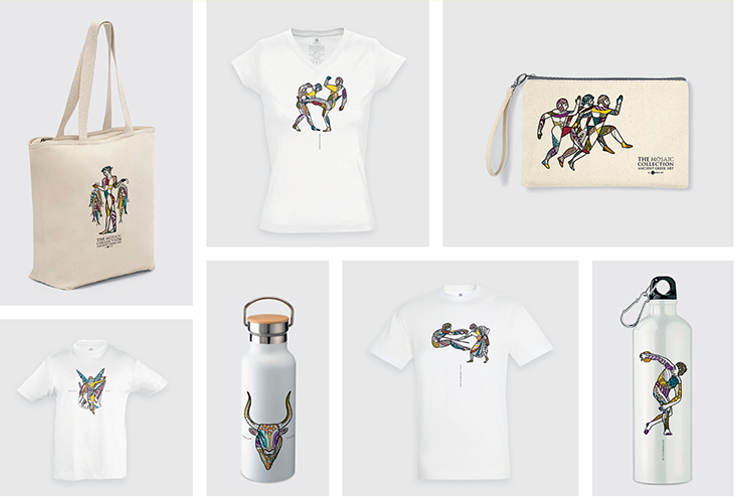
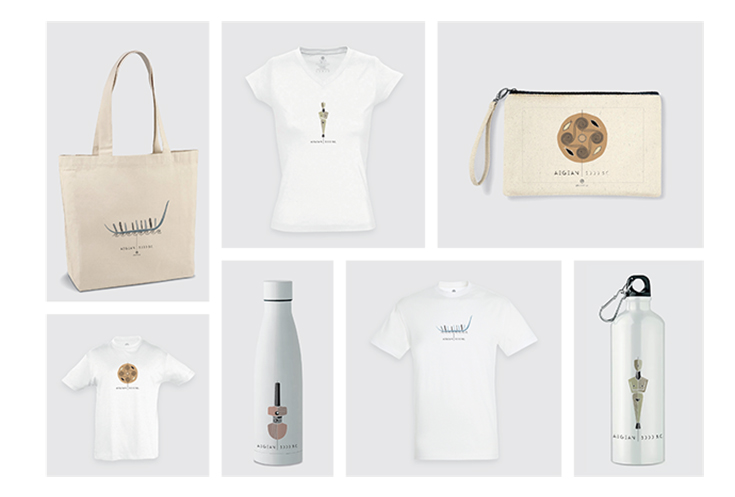
Inspired by masterpieces of ancient art, the collections respectfully “revive” classical creations by transforming them in a modern pop look. Design proposals with themes from the ancient Olympic Games, from works of the Cycladic civilization, from cult and decorative motifs of the ancient Greek world. Clothes and everyday objects are transformed into high aesthetic value and enjoyment creations.
The internal dividing lines and coloring are the inspiration of our designers and are not related to the coloring of the original ancient works.
Mosaic: Stella Stergiou (design), Maria-Christina Katsichti (color and graphic design)
Aegean 3000 BC: Maria-Christina Katsichti (design, color and graphic design)
Mosaic Collection

PARTHENON (west view)
The temple is dedicated to Athena Parthenos, the patron of Athens. It was built at the peak of Athenian democracy, under the leadership of Pericles, and replaced earlier temples dedicated to the goddess. It was designed by architects Iktinos and Kallikrates.
447-438 BC, Athens

MINOAN TAURUS
Stone bull’s head rython (cult vessel for making liquid offerings) found in the excavations of the “Little Palace” at Knossos, Crete.
1.600-1.500 BC, original: Heraklion Archaeological Museum

OWL OF ATHENA
The Athenian silver tetradrachm was stamped on the reverse with the symbol of the city, the owl of the goddess Athena, along with the sacred olive sprig and the inscription “of the Athenians”. It effectively became the standard coin of the Antiquity, spreading well beyond the borders of the Greek World.
ca. 440-420 BC, original: Numismatic Museum,
Athens

STADION RACE
The stadion was the earliest known event in the Olympic Games and the most prestigious footrace of the ancient Panhellenic Games. Its modern equivalent is the 200 m. sprint.
ca. 530 BC, original: Terracotta amphora, The Μetropolitan Museum of Art, New York, USA

THE VERGINA SUN
The sixteen rayed Sun was depicted on the lid of the golden larnax of King Philip II, father of Alexander the Great. The coffin was found in the royal necropolis of Aigai, the original capital of the Macedonians in northern Greece. From a generic decorative element, the star turned into the official emblem of the Kings of Macedonia.
4th century BC, original: Polycentric Museum of Aigai / Royal Tombs

THERA’s FISHERMAN
One of the frescoes found in the excavations of the neolithic settlement of Akrotiri at Thera (Santorini). The island was devastated by the Minoan eruption.
ca. 1.600 BC, original: late 17th century BC, Museum of Prehistoric Thera, Santorini

SELENE’S HORSE
Marble statue from the east pediment of the Parthenon now in the British Museum, London, UK. This is the head of one of the horses that drew the chariot of the Moon goddess Selene. Two other horses and Selene’s torso are in the Acropolis Museum, Athens.
5th century BC

HORSEBACK RACE
The jockeys were small boys, most likely slaves, who rode without a saddle using only reins and a small whip. The distance covered was six stadia (about 1.2 km).
ca. 490 BC, original: Terracotta amphora, The Μetropolitan Museum of Art, New York, USA

DISCUS THROW
The discus throw was one of the events of the ancient Greek pentathlon. It has been the subject of a number of wellknown ancient Greek statues and Roman copies such as the Discobolus and Discophoros.
450 BC, original: The Discobolus by Myron, reproduction, 2nd century AD, Staatliche Antikensammlungen und Glyptothek, Munich, Germany

THE SNAKE GODDESS
One of the famous statuettes used in religious or ritual ceremonies in the Central Palace Sanctuary of Knossos.
1.600-1.500 BC, original: Heraklion Archeological Museum

EVIL EYE (MATI) CHARM
A marble eye (μάτι/mati in Greek) which was once attached to the prow of a trireme. Eyes painted on the bows of vessels were and still are commonplace throughout the Mediterranean and beyond, a tradition spanning thousands of years to ward off evil and misfortune.
ca. 500 BC, original: Archaeological Museum of Piraeus

JAVELIN THROW
It was one of the events of the ancient Greek pentathlon. The elder wood javelin was tipped in bronze and was wrapped around the middle with a thin leather stripe, which would unfold when the javelin was thrown, spinning it and propelling it forward.
ca. 440-430 BC, original: Attic cylix, Altes Museum, Berlin, Germany

PENTATHLON – LONG JUMP
The athletes utilized weights called halteres in order to add further thrust to their jumps. They released them right before landing. The Hellanodikas depicted on the right was one of the judges and umpires of the games.
500-490 BC, original: Cylix (drinking cup) by Onesimos, Museum of Fine Arts, Boston, USA

PANKRATION
The most violent, dangerous but also fascinating ancient competition. It combined wrestling and boxing while kicking was also allowed. In Greek Mythology, it is thought that Pankration was developed by Heracles in his brutal fight against the Nemean lion.
ca. 500 BC, original: Terracotta amphora, The Μetropolitan Museum of Art, New York, USA

TETHRIPPON
The four-horse chariot race (tethrippon) was the most popular variant of the Olympic horse races. Regardless of the charioteer, the winner was the owner of the horses so a woman could
win a victory even though women were prohibited from attending the games.
ca. 500 BC, original: Terracotta Attic amphora, The Μetropolitan Museum of Art, New York, USA

GODDESS NIKE
Τhe ethereal female fi gure of Nike, the messenger of almighty Zeus, fl ies from mount Olympus to announce victory. Made by carver Paionios, the statuary was dedicated to Zeus, placed in his temple in Olympia..
original: A plaster model of the original Nike statue, Michael Tombros, 1919, Archaeological Museum of Olympia
Aegean 3000 BC Collection

FEMALE FIGURINE
This elegant fi gurine, one of the masterpieces of Cycladic marble sculpting, seems to stress those feminine attributes that are directly associated with fertility, reproduction and maternity.
2.800-2.300 BC, original: Museum of Cycladic Art, Athens

SHIP CUT INTO A ROCK
An entire fl eet was found etched into rock in Strofi las settlement in Andros island. Strofi las was fortifi ed and is considered the largest extant Neolithic settlement of the Aegean.
4.500-3.200 BC, original: sketch by the archaeologist Ch. A. Televantou, Director of the Strofilas excavation, Andros island

VIOLIN-SHAPED FIGURINE
The violin shaped fi gurines are the earliest manifestation of Cycladic sculpture, named because their contour resembles that of a violin. The form of these fi gurines renders schematic views of the female body. They presumably served as amulets or talismans.
3.200-2.700 BC, original: Museum of Cycladic Art, Athens

AEGEAN SUN
Cycladic “frying-pan”, Early Bronze Age type which is named after its characteristic skillet shape. Nonetheless, its use remains mainly unrevealed.
2.800-2.300 BC, original: National Archaeological Museum, Athens
THERA’S FISHERMAN
Ο ΝΕΑΡΟΣ ΨΑΡΑΣ – ΘΗΡΑ
Τοιχογραφία με την τεχνική της νωπογραφίας που αποκαλύφθηκε κατά τις ανασκαφές του καταστραμμένου από την λεγόμενη Μινωική έκρηξη (περίπου στα τέλη του 17ου αιώνα π.Χ.) προϊστορικού οικισμού στο Ακρωτήρι Θήρας (Σαντορίνη).
Μουσείο Προϊστορικής Θήρας (Σαντορίνη).
MINOAN TAURUS – KNOSSOS
ΜΙΝΩΙΚΟΣ ΤΑΥΡΟΣ – ΚΝΩΣΣΟΣ
Το διάσημο αριστουργηματικό λίθινο ρυτό (δοχείο για πόσιμα υγρά ή χοές κατά τη διάρκεια λατρευτικών τελετών) σε σχήμα ταυροκεφαλής που βρέθηκε στο Μικρό Ανάκτορο της Κνωσσού.
Αποτελεί ένα από τα επιφανέστερα έργα της μινωικής τέχνης και χρονολογείται περί το 1600-1500 π.Χ.
Αρχαιολογικό Μουσείο Ηρακλείου (Κρήτη).
SELENE’S HORSE – PARTHENON
ΤΟ ΑΛΟΓΟ ΤΗΣ ΣΕΛΗΝΗΣ – ΠΑΡΘΕΝΩΝΑΣ
Μαρμάρινο άγαλμα από το ανατολικό αέτωμα του Παρθενώνα που σήμερα βρίσκεται στο Βρετανικό Μουσείο. Είναι το κεφάλι ενός από τα άλογα του άρματος της θεάς του φεγγαριού Σελήνης ή Πασιφάης. Δύο άλλα άλογα βρίσκονται στο Μουσείο Ακρόπολης στην Αθήνα.
Τα γλυπτά του Παρθενώνα, Βρετανικό Μουσείο (Λονδίνο, HB).
OWL OF ATHENA
Η ΓΛΑΥΚΑ ΤΗΣ ΘΕΑΣ ΑΘΗΝΑΣ
Παράσταση της γλαύκας (κουκουβάγιας), του συμβόλου της πόλης των Αθηνών με κλαδί ελιάς, του ιερού φυτού της πόλης και την επιγραφή ΑΘΕ. Η παράσταση υπήρχε στην πίσω όψη του αρχαίου αργυρού τετράδραχμου των Αθηνών που απετέλεσε το πλέον διαδεδομένο νόμισμα από τον 5ο αιώνα π.Χ. μέχρι την εποχή του Μεγάλου Αλεξάνδρου. Σήμερα η παράσταση υπάρχει στην ελληνική όψη του κέρματος του ενός ευρώ.
 No products in the cart.